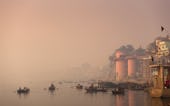
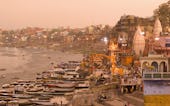
Varanasi is the India of your imagination. This is one of the world's oldest continually inhabited cities, and one of the holiest in Hinduism. Pilgrims come to the Ganges here to wash away sins in the sacred waters, to cremate their loved ones, or simply to die here, hoping for liberation from the cycle of rebirth.
Most visitors agree Varanasi is magical – but not for the faint-hearted. Intimate rituals of life and death take place in public, and the sights, sounds and smells of the mazelike old town – not to mention almost constant attention from touts – can be intense. Still, the so-called City of Light is one of the most colourful and fascinating places on earth. Strolling the ghats or watching sunrise from a boat on the Ganges are a highlight, and confronting the reality and ritual of death can be a powerful experience.
Manikarnika Ghat, the main burning ghat, is the most auspicious place for a Hindu to be cremated. Dead bodies are handled by outcasts known as doms, and are carried through the alleyways of the old town to the holy …
Varanasi’s liveliest and most colourful ghat. The name indicates that Brahma sacrificed (medh) 10 (das) horses (aswa) here. In spite of the persistent boat owners, flower sellers, massage practitioners, and touts tr…
The furthest south of the main ghats and one of the biggest, Assi Ghat is particularly important as the River Assi meets the Ganges near here and pilgrims come to worship a Shiva lingam (phallic image of Shiva) bene…
Harishchandra Ghat is a cremation ghat – smaller and secondary in importance to Manikarnika, but one of the oldest ghats in Varanasi.
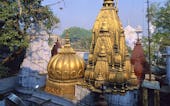
There are temples at almost every turn in Varanasi, but this is the most famous of the lot. It is dedicated to Vishveswara – Shiva as lord of the universe. The current temple was built in 1776 by Ahalya Bai of Indor…
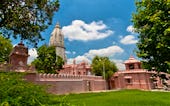
Long regarded as a centre of learning, Varanasi’s tradition of top-quality education continues today at Banares Hindu University, established in 1916. The wide, tree-lined streets and parkland of the 5-sq-km campus …
On the Banares Hindu University campus, this museum hosts a wonderful collection of miniature paintings, as well as 12th-century palm-leaf manuscripts, sculptures and local history displays. No cameras.
Munshi Ghat – also known as Darbhanga Ghat – is one of the more photogenic ghats along the old town stretch of the Ganges in Varanasi.
A colourful ghat with many steps and a small pool, where a fire aarti is held every evening at 6.30pm.
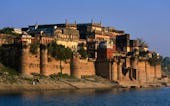
This crumbling 17th-century fort and palace, on the eastern bank of the Ganges, isn't a prime attraction, but the eccentric museum has some interesting displays and the attached Vyas Temple is a beautiful place to w…
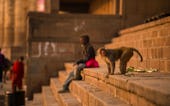
This temple, dedicated to the goddess Durga, was built in the 18th century by a Bengali maharani and is stained red with ochre. It's also known as the 'monkey temple' as lots of simians like to hang out here.
Named after a 16th-century Hindu poet, Tulsi Ghat has fallen down towards the river, but in the month of Kartika (October/November) a festival devoted to Krishna is celebrated here.
Just north of Dashashwamedh Ghat, Man Mandir Ghat was built in 1600 by Raja Man Singh and later housed an observatory. The northern corner of the ghat has a fine stone balcony.
The walls of this modern, marble, sikhara-style temple are engraved with verses and scenes from the Ram Charit Manas, the Hindi version of the Ramayana.
Dominating Panchganga Ghat, this small mosque was built by Aurangzeb on the site of a large Vishnu temple.
A small Shiva temple and a 19th-century mansion built by Nepali royalty sit back from Shivala Ghat, built by the local maharaja of Benares.
Scindhia Ghat was originally built in 1830, but was so huge and magnificent that it collapsed into the river and had to be rebuilt.
Popular with Rama devotees (Hanuman was Rama's stalwart ally in his quest to rescue Sita from the demon Ravana).
North from Scindhia Ghat, Ram Ghat was built by a maharaja of Jaipur.
Dattatreya takes its name from a Brahmin saint, whose footprint is preserved in a small temple nearby.
At Trilochan, two turrets emerge from the river, and the water between them is especially holy.
Famed for its impressive, 76m-high marble tower. On the campus of Banares Hindu University.
Just beyond Ram Ghat, this ghat marks where five holy rivers are supposed to meet.
This minor ghat was named after the female Maratha ruler of Indore.
Lots of laundry is spread to dry at this ghat along the Ganges.
This small ghat is marked by three Jain temples.
Foreigners should enter gate 2 (the Hindu exit) for access to Vishwanath Temple.
A painted stone Nandi statue and lingam mark this ghat north of the mosque.
The Dandi Ghat is used by austere ascetics known as Dandi Panths.
One of Varanasi's oldest and most important churches.

No comments:
Post a Comment